Growth that costs too much
Spend goes up without the unit economics under it. CAC drifts away from what a first order returns. Top line climbs while contribution margin quietly compresses.
The growth operating system for eight-figure Shopify brands
The Growth Audit scores your brand across four pillars, offer, conversion, distribution and creative, so you know exactly where to work next. It turns a diagnosis into an order of work, and an order of work into margin.
Brands we already run ads for
The problem…
Every scaling brand lives or dies on these four. Three of them are usually fine. Almost no team can name the one that is throttling them right now, which is the only one worth the next ninety days.
Spend goes up without the unit economics under it. CAC drifts away from what a first order returns. Top line climbs while contribution margin quietly compresses.
The ad does its job. The site does not. Pages do not echo the promise the ad made, conversion rate sits flat, and nobody owns post-click as a discipline.
Signal half-reported, attribution argued over, frequency unchecked. The account gets run against a platform number nobody fully trusts.
Winners are not isolated against CPA. Two ads carry most of the spend. The pipeline runs dry the week the algorithm most needs feeding.
Four pillars, twenty checks, one hundred points. Each pillar is marked out of 25. The lowest one is the binding constraint, and it is where the next ninety days go.
That is the audit itself, running on a sample account. Open a pillar and read the checks, the scores and the evidence under them. Nothing in it is a real client's data.
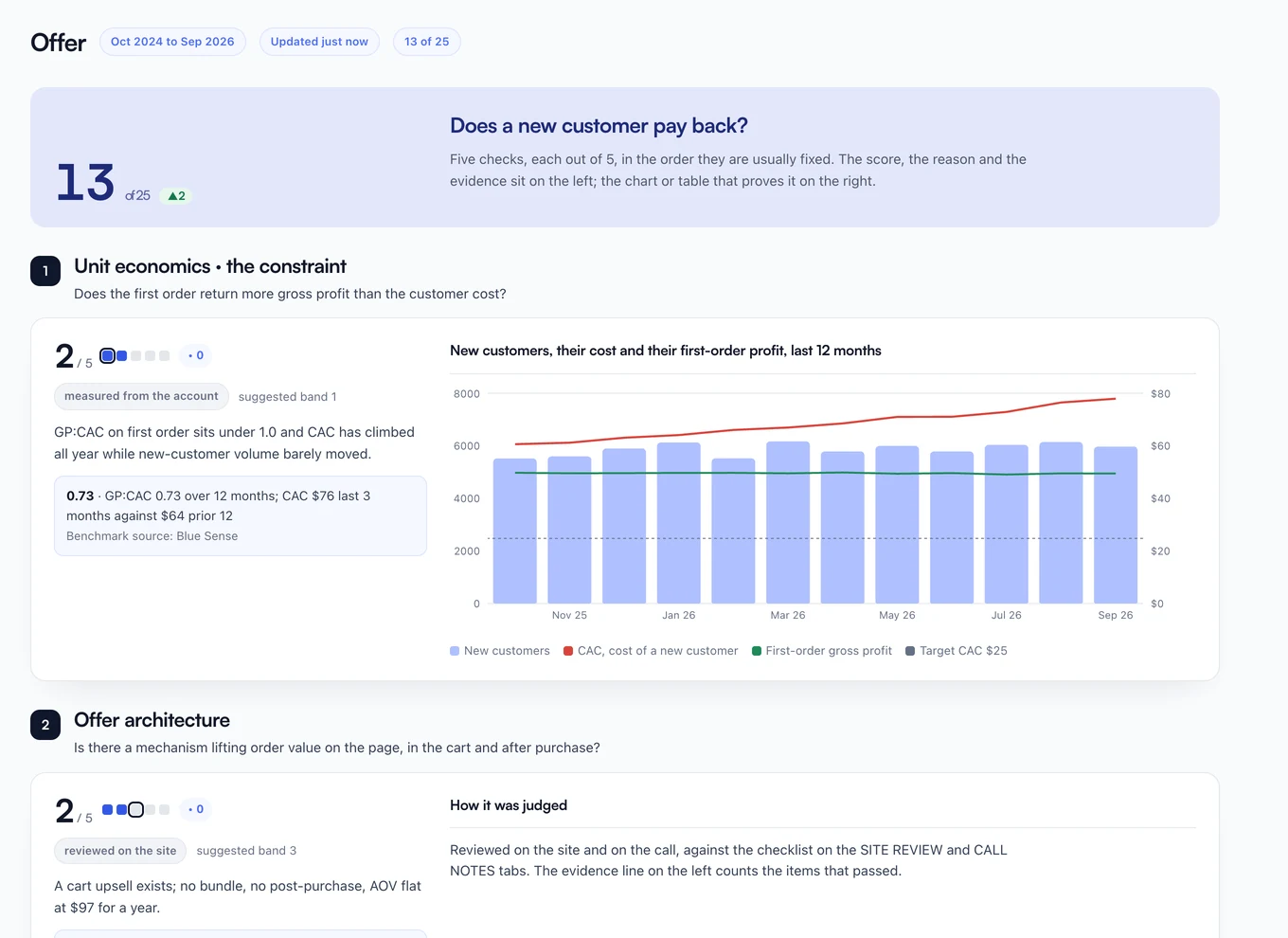
Most CPA problems are offer problems wearing a creative costume. If the first order cannot pay for the customer, better ads only buy the loss faster.
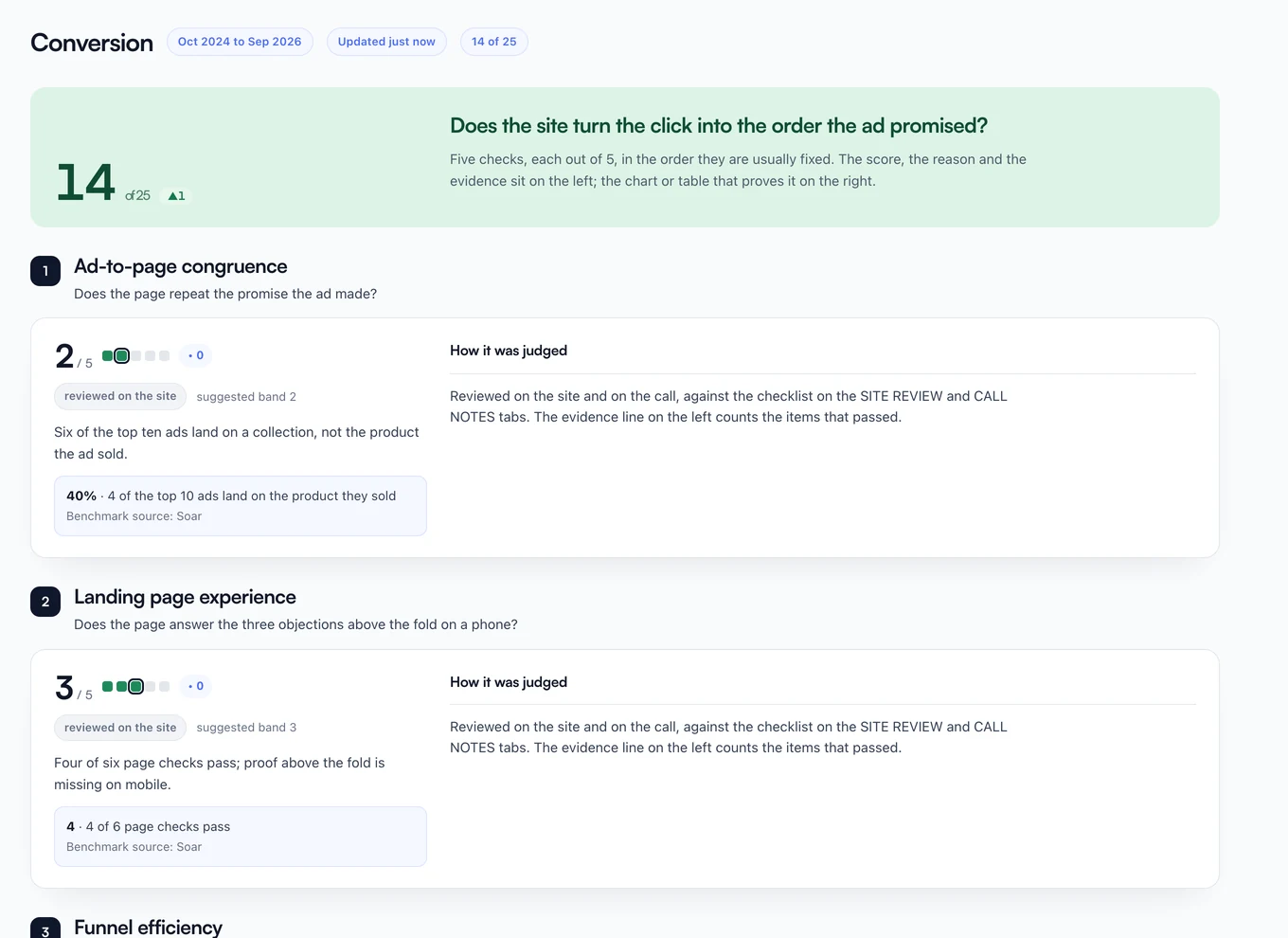
Post-click is where conversion rate goes quietly, and it is the one discipline nobody owns by default.
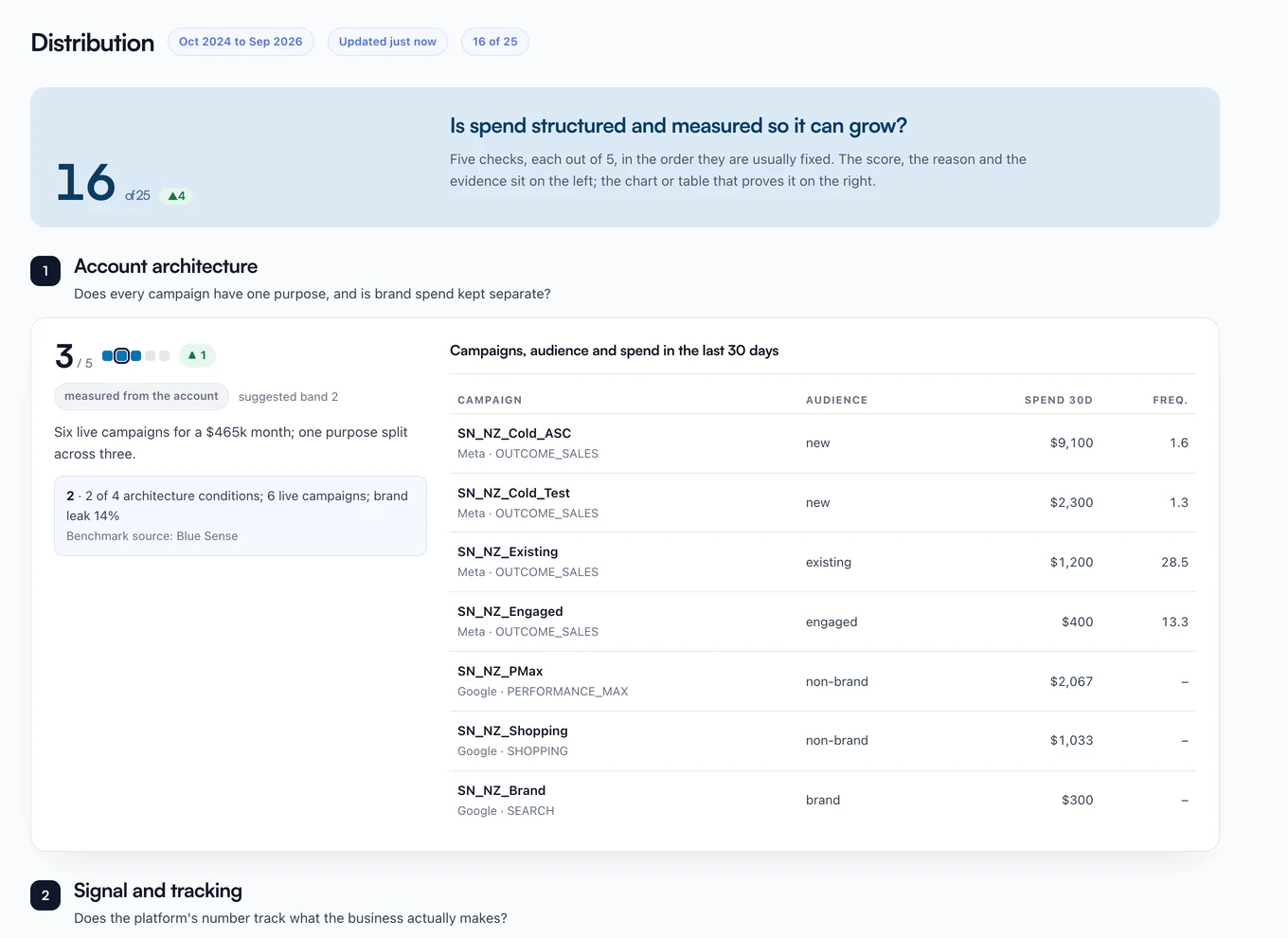
This is where "I pushed spend and ROAS dropped" comes from. The money had nowhere clean to go, so the algorithm spent it on people you already had.
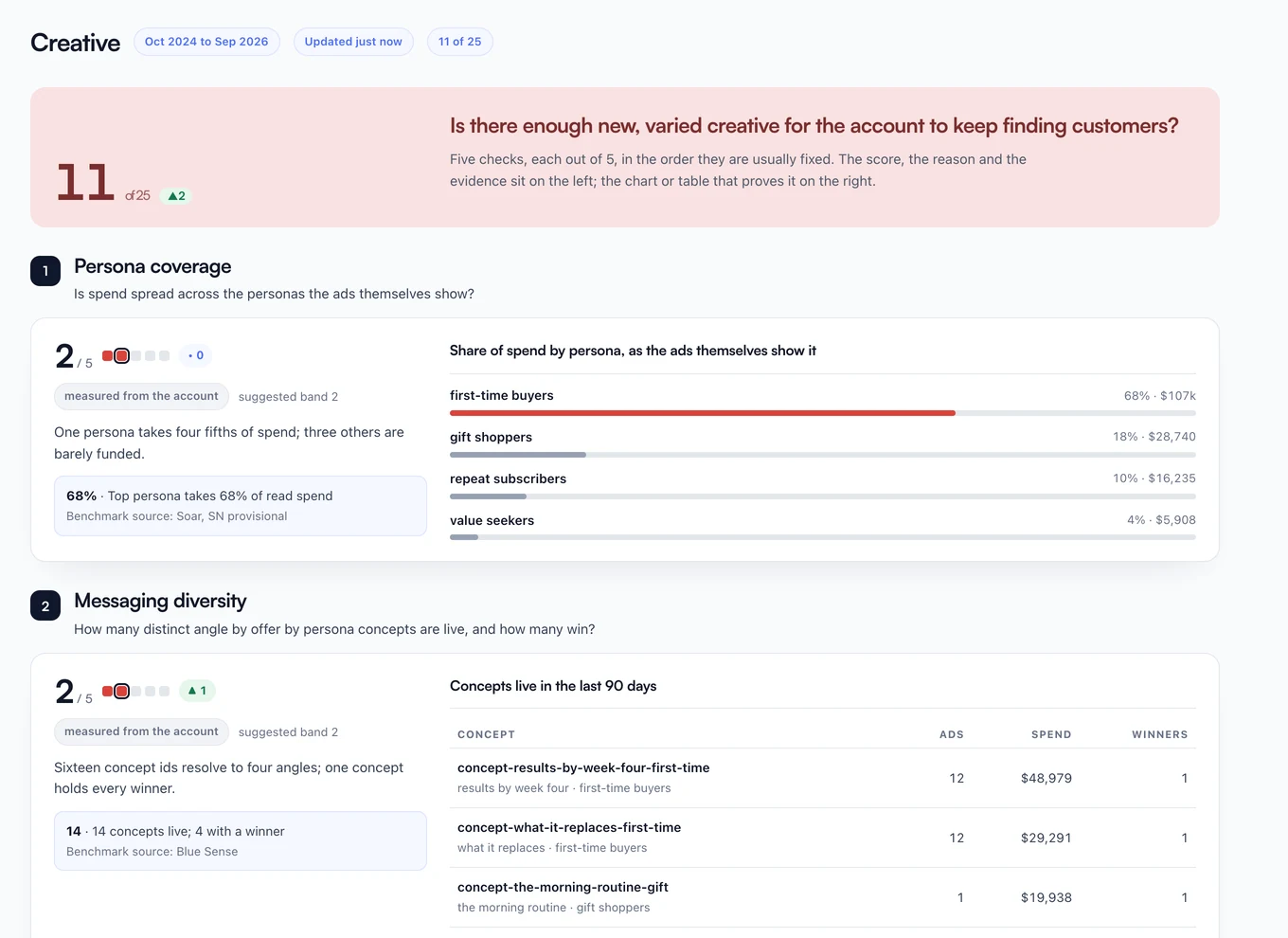
Creative is stock, not a one-off. It wears out, and the replacement has to be in testing before the current one goes. Model it, or find out the week you can least afford to.
Each one is a question with an answer in your data, a score out of five, and the evidence that produced it. No opinions, no benchmarks borrowed from someone else's account.
Does the first order return more gross profit than the customer cost?
Is anything lifting order value on the page, in the cart and after?
Is the spend behind the products that can carry a customer's cost?
Does a customer keep paying after the first order, and how fast?
Does the page say in one sentence why it is worth the price?
Does the page repeat the promise the ad made?
Does it answer the three objections above the fold on a phone?
Where between session and purchase do people leave?
Is the checkout clean, and is shipping shown before the address?
Is testing a habit with an owner and a log, or an occasional idea?
Does every campaign have one purpose, and is brand spend separate?
Does the platform's number track what the business actually makes?
Is existing-customer spend contained, with exclusions in place?
Is there a place to test, a winner rule, a path to scale, a kill rule?
Are changes made on a cadence, or on a whim?
Is spend spread across the personas the ads themselves show?
How many distinct angle by persona concepts are live, and how many win?
Are enough new ads launched for the spend, and do enough of them hit?
Are formats varied, and is every funnel stage covered?
How much rides on the top two ads, and is the next winner in testing?
Nothing here is homework. The only thing we need from you is access.
Fit checked, read access to Shopify and the ad accounts granted, on the call and on screen.
Two years of your numbers built out, then every campaign, ad set and ad read and scored.
Thirty to forty five minutes, your numbers on screen. The recording, the workbook and the plan are yours.
Argue with the findings. Run the plan with us, or hand it to your own team.
Free, and built on your numbers rather than a template. The score, the evidence and the ninety-day order are yours whether or not we ever work together.
Eight quick questions, then pick a time.
Your details are already filled in.